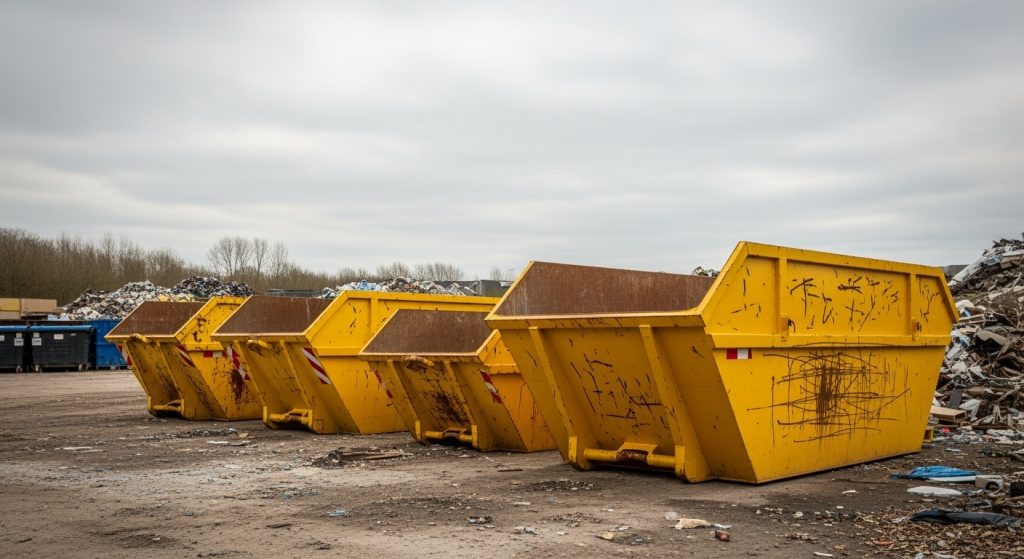
If you’ve ever found yourself staring at a skip’s booking page wondering, why are skips measured in yards? , you certainly aren’t alone. It’s a common question in the skip industry.
While the UK has largely embraced the metric system, for some reason, skips are measured in imperial measurements.
The answer to why are skips measured in yards? They actually mean cubic yards.
It’s a measurement of volume (how much 3D space is inside the container), rather than just the length of it. An 8-yard skip doesn’t mean the metal bin is 8 yards long; it means it can hold 8 cubic yards of waste.
For most people, picturing a cubic yard isn’t something that comes naturally. But getting your head around these measurements is the secret to a stress-free project. Knowing how skip sizing works means you won’t overpay for a massive container you don’t need, and saves you from the frustrating headache of hiring a skip that’s too small to finish the job.
Why do we still use cubic yards?
Skips are still measured in cubic yards mainly because it’s the long-standing industry standard. Waste management, construction and building traders were using cubic yards long before metric measurements became common in the UK, and the term has stuck.
It’s a simple shared language. Builders, tradespeople, skip hire companies and waste transfer sites all understand what a 4-yard skip or 8-yard skip means. It’s basically referring to the skip’s internal volume, not its length, width or height.
For anyone more familiar with metric measurements, 1 cubic yard is roughly 0.76 cubic metres. So, an 8-yard skip holds around 6.1 cubic metres of waste.
Volume vs Weight: Why yards and tonnes are not the same thing
A skip’s size in yards tells you how much space is inside it. Tonnes tell you how heavy the waste is. These are two different things, which is why a skip’s yard size doesn’t automatically equal its weight.
Is a 4-yard skip 4 tonnes?
A 4-yard skip is not technically a 4-tonne skip. It holds 4 cubic yards of waste. If you fill it with dense materials like soil, brick, hardcore or rubble, it may weigh around 3 to 4 tonnes. If you fill the same skip with cardboard, wood, old furniture or light household waste, it will weigh much less.
Is an 8-yard skip the same as an 8-tonne skip?
The same applies to an 8-yard skip. It holds 8 cubic yards of waste, but that doesn’t make it an 8-tonne skip. An 8-yard skip filled with heavy rubble or soil can get close to 8 tonnes, but the size still refers to volume, not weight. A lot of skip companies will recommend that 8-yard skips be the largest standard skip that’s suitable to fill with heavy materials. This is because larger skips that are filled with soil or hardcore can become too heavy for the lorry to lift and transport safely.
As a rule, it’s best to use smaller skips for very heavy waste and larger skips for bulky but lighter waste. Soil, bricks, tiles and concrete will quickly add weight. Furniture, packaging, wood, plastics and general household waste tend to take up space before they become too heavy.
The Skips Liverpool visual sizing guide
Skip sizes can be easier to understand when you picture them in bin bags. The exact number will depend on how full the bags are and what type of waste you’re throwing away, but these estimates are a useful guide.
Mini skips: 2 to 4 yards
Mini skips are best for small domestic jobs, like bathroom refits, garden clean-ups and minor DIY work. As a rough guide, they hold around 20 to 40 bin bags of waste.
Midi skips: 6 yards
A 6-yard skip is a good middle ground option for medium DIY projects, small renovation jobs and larger garden clearances. It usually holds around 50 to 60 bin bags.
Builders skips: 8 yards
The 8-yard skip is the go-to skip choice for domestic and trade projects. It’s commonly used for heavy construction waste, full room renovations, kitchen refits and general building waste. It usually holds around 70 to 80 bin bags.
What is the largest skip to hire?
For standard domestic skip hire, a 14-yard or 16-yard skip is usually the largest practical option. These are better suited to bulky but lighter waste like furniture, packaging and wood.
For commercial waste, the largest options are Roll-on Roll-off skips, sometimes called RoRo skips. These can go up to 40 or even 50 cubic yards, depending on the supplier. These are designed for construction sites; they’re not suitable for your home’s driveway.
Logistics, delivery and access
Choosing the right skip size is important, but so is making sure the lorry can actually deliver it.
How wide is a skip lorry?
A standard skip lorry is usually 2.5 to 2.6 metres wide, which is roughly 8ft 2in to 8ft 6in.
However, the lorry needs more than its own width to access the property safely. The driver needs clearance for mirrors, space to line up with the driveway and enough room to operate the lifting arms. As a general guide, you should allow at least 2.9 to 3.0 metres of access width, which is around 9ft 6in.
If your drive is too narrow, blocked or unsuitable, the skip might need to be placed on the road instead. In Liverpool, skips placed on a public road will need a skip permit from Liverpool City Council. We can apply for these on your behalf, but you’ll need to let us know at the time of booking if one is required; otherwise, we can’t drop off your skip without one.
Choosing the right skip size
Understanding the difference between yards and tonnes can save you time, money and hassle. Yards tell you how much waste a skip can hold, while tonnes tell you how heavy that waste is. Once you know the difference, it becomes much easier to choose the right skip for your needs and avoid paying for more space than you need.
If you’re still not sure which skip is the right one for you, speak to the team at Skips Liverpool. We can talk through your waste type, available access and project size before recommending the most suitable option.
You can book a skip online or call us on 0151 154 5698 for advice.